A 4-part Live Learning Series

AI Strategy Lab
for Social Justice
Advocates.

Critical analysis and grounded decision making for our collective future.

For justice-oriented leaders, advocates, organizers, educators, funders, nonprofit professionals, HR/DEI practitioners, policymakers, and change makers who want to understand AI with more clarity, rigor, and courage.

DatesTuesdays, June 16 / 23 / 30 / July 7
Time4–6pm PT · 7–9pm ET
FormatLive online, cohort-based
Sessions4 · 2 hours each
Cohort 2
$825
Cohort 2 is offered at a lower-than-standard rate as we continue to gather feedback and refine the experience. Future cohorts will be priced higher.
Reduced rates
Available
A limited number of reduced-rate spots are available for low-income/low-wealth folks. No explanation or proof of need required. Email Michelle for the access code.

What is AI literacy
in the context of social justice?

No matter which way you turn, everyone seems to be talking about AI.

You may be hearing big claims about its limitless potential. You may be reading sharp critiques about AI corporate powers, algorithmic bias, and environmental harm. You may see your peers suddenly become an overnight AI expert and feel anxious that you might be falling behind. You may be wondering what your role is in all of this, and feel the pressure to figure it all out as quickly as the world seems to demand it.

Regardless of where you stand, one thing is clear: the impact of AI is already being felt by many, and it's spreading rapidly.

AI Strategy Lab for Social Justice Advocates is a live, online learning series designed for change agents who want to understand AI with more groundedness, clarity, and rigor. We are here to slow down the panic and give you a clear place to process the complexity. Across four live sessions, we will move beyond hype, panic, and abstract concern to building a solid foundation for understanding what AI is, how it works, and how to make sense of the range of opportunities and harms that exist. We will examine concrete case studies, practice making complex decisions around AI usage, intervention, and accountability, and restore agency by creating practical options beyond all-or-nothing. You will leave with better questions, immediately useful tools, and more confidence to participate in shaping our future.

AI systems are already being embedded into schools, workplaces, media, and everyday decision-making at a speed and scale we simply cannot ignore.

This series is an invitation to locate yourself in the struggle.

Your expertise already matters. This course will help you understand where and how to use it.

This series is for you if…
  • You feel behind on AI conversations but know they matter.
  • You are concerned about AI's social justice implications and want more concrete analysis.
  • You are being asked to respond to AI in your organization, field, or community.
  • You want to move beyond abstract critique to strategic interventions.
  • You are trying to discern what uses of AI are acceptable, risky, harmful, or unacceptable.
  • You believe social justice leaders need a stronger voice in shaping the future of technology.
This series is not about
  • Prompt engineering.
  • Productivity hacks.
  • Technical implementation.
  • Transitioning into a tech career.
  • Comprehensive legal compliance or policy training.
  • Easy answers.

Four sessions of Best-In-Class Experiential Learning.

01

AI Fundamentals

Current technical and ethical landscape

We'll begin by demystifying AI and contextualizing the moment: what it is, what it is not, how it works, and why it matters now. We'll examine the dominant narratives surrounding AI and clarify how a social justice lens can be applied to the AI lifecycle.

Core questions
  • What is AI, really?
  • What is being overstated, misunderstood, or obscured?
  • What systems does AI move through to get to us?
  • What is my point of view and role in all of this?
Practice tool AI Supply Chain & Power Analysis
02

The Dual Edge of AI

When opportunity meets systemic harm

AI is often framed as either breakthrough or threat. The reality is more complicated. This session explores how AI can create real possibilities while also reproducing and amplifying existing inequities. We'll examine three categories of harm and practice distinguishing between fixable errors and structural harm.

Core questions
  • What opportunities does AI create, and for whom?
  • What inequities are being inherited, encoded, or amplified?
  • Is this a redesign problem, a governance problem, or an existence problem?
  • What happens when the harm scales?
Practice tool AI Harm Diagnosis Framework
03

Grounded Decision Making

Choices beyond all or nothing

Once we understand the risks, what do we do? This session strengthens our sense of agency by introducing a broader decision menu. We will work through real-world scenarios and practice asking sharper questions about purpose, accountability, foreseeable harm, human oversight, and values-based tradeoffs.

Core questions
  • What options exist beyond use it or ditch it?
  • What are the tradeoffs and how do we decide what is worth the cost?
  • What questions should I be asking before making the decision?
Practice tool AI Decision Matrix
04

Collective Courage

Building sustainable conditions

In the final session, we'll look toward the future of AI, work, power, and social change. We'll explore the skills and capacities justice leaders need in this moment: critical thinking, ethical governance, principled conflict, change management, and more. We'll close by returning to collective courage—how we confront what is true, name what matters, act with discernment, and sustain ourselves and each other through ongoing change.

Core questions
  • What skills and expertise do I already have that can serve my community?
  • What capacities do I need to build next?
  • How do we build sustainable conditions for courage?
Practice tool Collective Courage Framework + Action Plan

Interactive
Learning

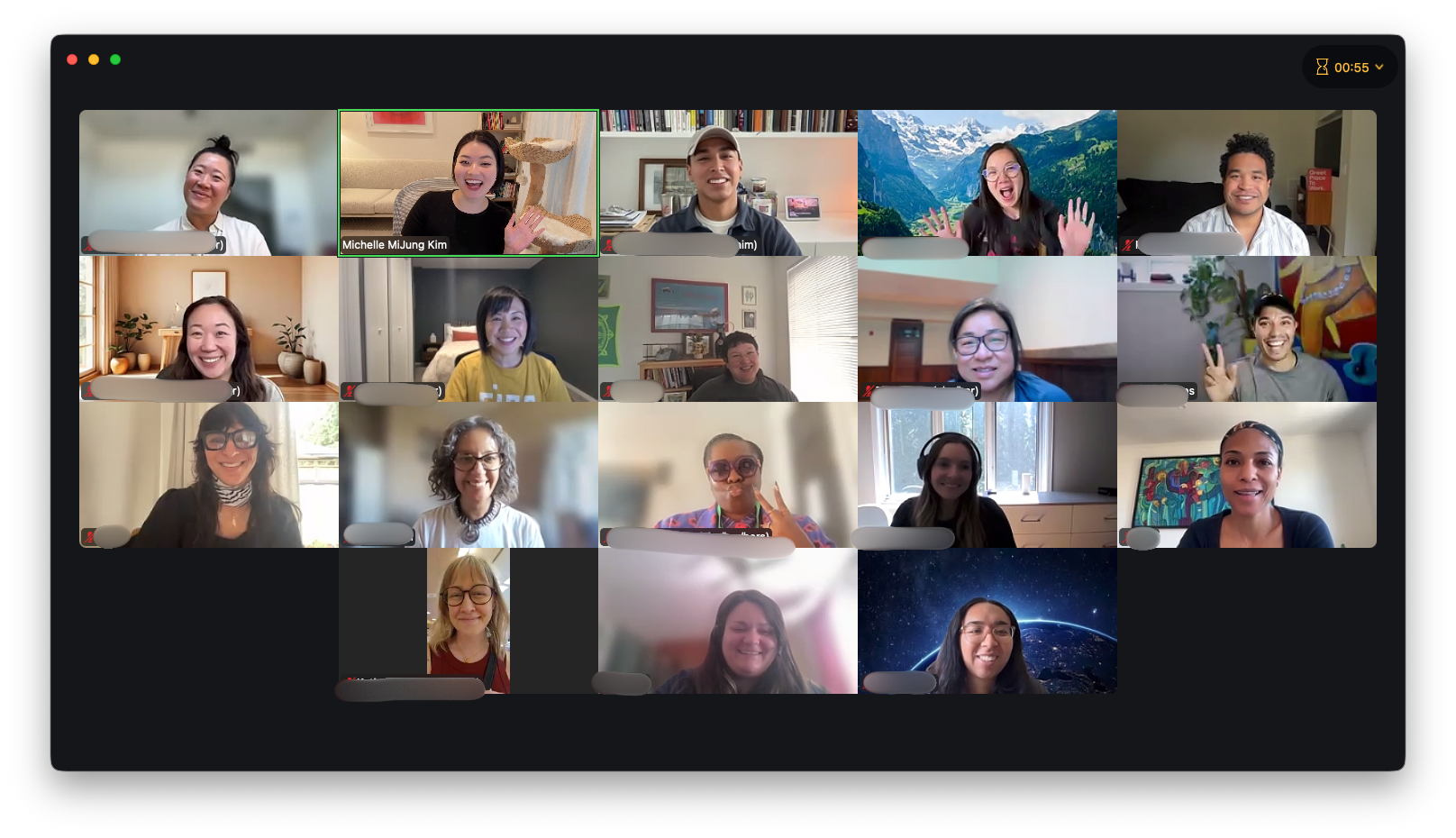
Each session includes lectures, guided reflection, real-world examples, small-group discussion, and group exercises.

The emphasis is on practicing analysis and discernment, not passively receiving information. Please join the session ready to engage and use your critical thinking skills!

Tools, language,
and a sharper point
of view.

01 A clearer understanding of AI fundamentals without needing a technical background.
02 A stronger ability to analyze AI through a social justice, power, and accountability lens.
03 Practical tools for evaluating AI-related risks and tradeoffs.
04 Language for asking better questions in your organization, field, or community.
05 A grounded framework for making decisions under pressure.
06 An honest assessment of your own AI redlines, commitments, and next steps.
07 The latest resources, data, and insights on AI and social justice.
08 A community of justice-oriented leaders learning alongside you.

See the full series outline for more on session goals.

Behind
the work.

build your
brave.
Michelle MiJung Kim
Founder & lead facilitator

Michelle MiJung Kim is an award-winning author, speaker, entrepreneur, and lifelong social justice activist whose work sits at the intersection of personal transformation and systemic change. She is the founder and CEO of The Courage Studio, a strategy lab and practice ground for collective courage.

Michelle began her career in management consulting and moved into senior leadership roles in tech startups, where she experienced first-hand how innovation, power, workplace culture, and social impact collide.

Michelle brings a grounded perspective to conversations about AI, shaped by her 13+ years of experience in the tech industry, and her own hands-on exploration of AI tools, local LLMs, and agentic workflows.

In this series, Michelle brings together her background in social justice, leadership and organizational change, and technology to help people understand AI, analyze risks and tradeoffs, and make grounded decisions for the communities and futures they are working to protect.

Michelle is the author of The Wake Up and the host and producer of I Feel That Way Too, a 2x Signal Award winning narrative podcast. She co-founded and served as the CEO for Awaken, a DEI education company serving Fortune 500, tech giants, nonprofits, and universities.

Her work has been featured in Harvard Business Review, Forbes, The New York Times, NPR, and MSNBC. She is a LinkedIn Top Voice, a Fast Company Queer 50 honoree, and the recipient of the Nautilus Gold Award. Across her work, Michelle helps people and organizations move through uncertainty with greater clarity and courage.

Michelle currently serves on the board of Asian Americans for Civil Rights and Equality (AACRE), and is a proud alumna of UC Berkeley’s Haas School of Business. She lives in Oakland, California with her two rambunctious orange cats.

"Your expertise already matters.
You just have to understand where and how to use it."

More about Michelle's work → michellemijungkim.com

A strategy lab and practice ground for collective courage.

The Courage Studio develops ideas, experiences, and cultural artifacts that build the conditions for courageous change.

We believe courage is not only an individual act, but a collective practice that can be strengthened. In a time of accelerating change, concentrated power, and deep uncertainty, we strive to create spaces, ideas, and work that expand our capacity to take risks and lead courageously.

If you are interested in experimenting with us, email hello@thecouragestudio.com.

Common
questions.

Do I need a technical background?
No. This series is designed for non-technical leaders and practitioners. You do not need to know how to code or use AI tools.
Will this teach me how to optimize my AI workflow?
No. This is not a prompt engineering or productivity course. The focus is critical understanding, harm and opportunity analysis, decision-making, and social justice strategy.
Is this anti-AI or pro-AI?
Well, it depends on how you define AI (we'll get into this together). But this course is not meant to convince you that AI is either good or bad. It is designed to help you think clearly about where AI creates harm, where it may create possibility, what tradeoffs are involved, and what decisions are most aligned with *your* values.
Who is this best suited for?
This series is especially relevant for nonprofit leaders, funders, advocates, policymakers, HR and DEI practitioners, cultural workers, and anyone in a position to influence decisions about technology, people, policy, or community impact.
Do I have to attend all 4 sessions?
Yes. In addition to learning the material, the course is designed to help you build community with people in your cohort. Given the limited space, we are prioritizing people who can make all 4 sessions.
Are scholarships available?
Yes. There will be a limited number of reduced-price tickets. Email Michelle for the access code.
Can I sign up with my whole team?
Yes, but space is limited. If you are interested in providing the series to your organization, please reach out to Michelle directly at michelle@thecouragestudio.com.
Will this series happen again?
Yes, but we don't have any future dates planned yet. Get on the waitlist to be notified when the next cohort opens.
Don't wait!

Meet the moment with clarity,
courage, and discernment.

AI is already shaping the future of work, culture, knowledge, power, and public life. The question is not whether social justice leaders should care—it is whether we are equipped to meet the moment with clarity, courage, and discernment.

Register Before Seats Fill Up!

Everything you need
to decide.

DatesTuesdays
June 16, 23, 30, July 7
Time4–6pm PT
7–9pm ET
FormatLive online,
cohort-based
Cohort 2 rate$825
Sessions4 · 2 hours each
PrerequisiteNone

Can't join
this time?

Get on the waitlist and we'll let you know when the next cohort opens. No spam, no list swap.

Join the waitlist
Be first in line
for the next cohort.
We'll only use your name and email to notify you when the next cohort opens. Unsubscribe anytime, or email hello@thecouragestudio.com to be removed.
You're on the list Thank you. We'll be in touch when the next cohort opens.